Situation
Credit-default classifiers are often judged on accuracy alone, which hides the real cost imbalance between missed defaults and unnecessary false alarms.
Financial Analytics
An end-to-end classification and reporting project covering preparation, imbalance-aware comparison, threshold selection, and credit-default risk communication.
View source repository↗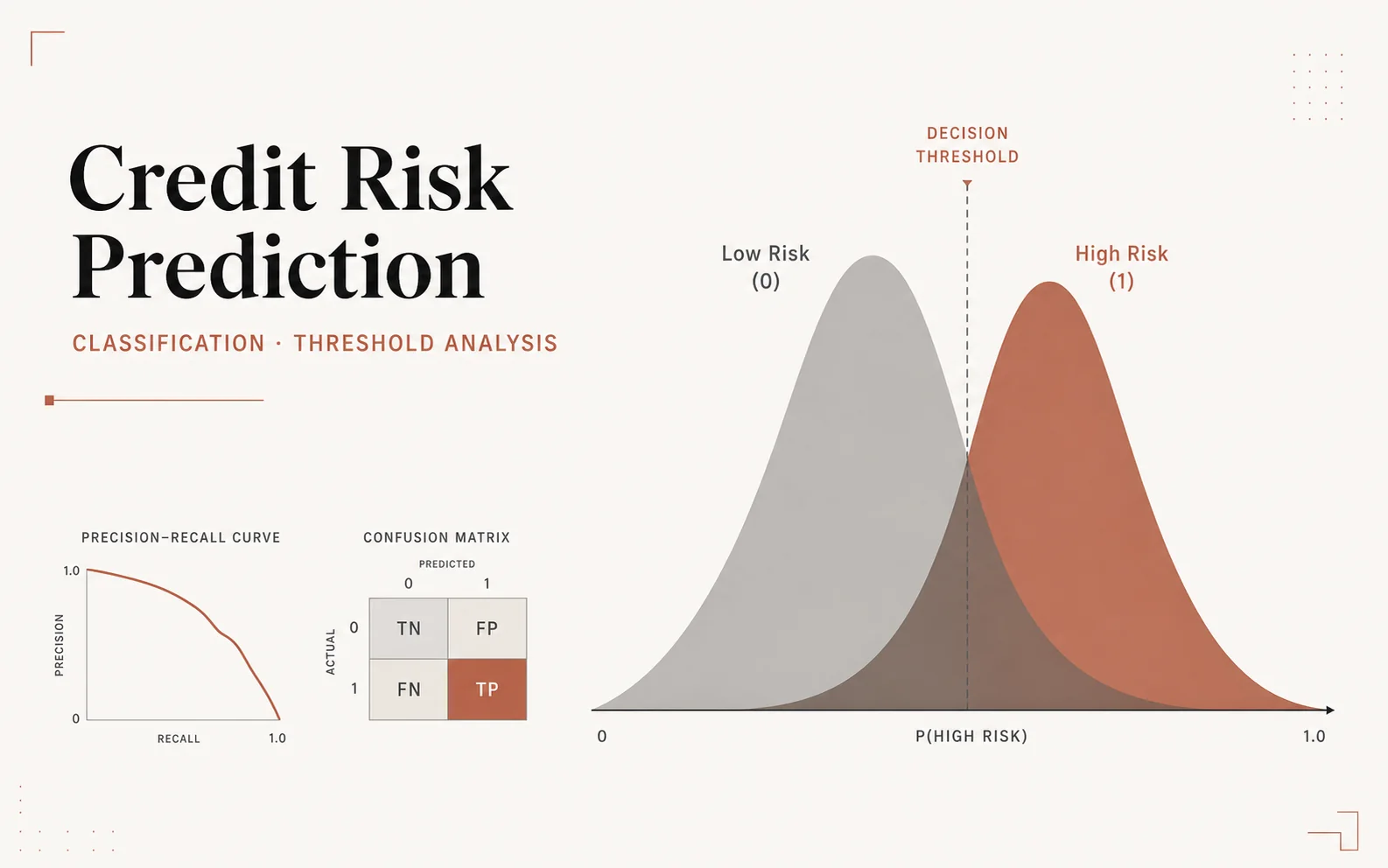
Why it matters
My role
Credit-default classifiers are often judged on accuracy alone, which hides the real cost imbalance between missed defaults and unnecessary false alarms.
Build an imbalance-aware default-classification workflow that compares models on the metrics that actually matter for lending decisions, then communicates the trade-offs in decision language.
The final report explains model trade-offs and limitations in decision language rather than a metric dump, demonstrating both the analytical work and the ability to communicate it to a non-technical audience.
Technical implementation
Each layer connects an implementation choice to the decision or workflow it supports.
06 layers| Layer | Implementation | Operational purpose |
|---|---|---|
| Data preparation | Cleaning, encoding and validation of financial and demographic variables | Create a consistent modelling dataset while protecting test evidence |
| Class imbalance | Imbalance-aware training and evaluation focused on the default class | Prevent majority-class accuracy from hiding missed defaults |
| Model comparison | Logistic Regression, Random Forest and XGBoost | Compare an interpretable baseline with nonlinear ensemble models |
| Evaluation | ROC, precision-recall, F1, class precision, recall and confusion matrices | Measure both discrimination and the practical cost of classification errors |
| Threshold selection | Validation-based probability cutoff optimization | Balance missed defaults against unnecessary false alarms |
| Reporting | Structured analytical report covering method, evidence, trade-offs and limitations | Communicate model results in decision language rather than metric lists |
Product walkthrough
Frames the analytical question and establishes the report as a decision-oriented deliverable.
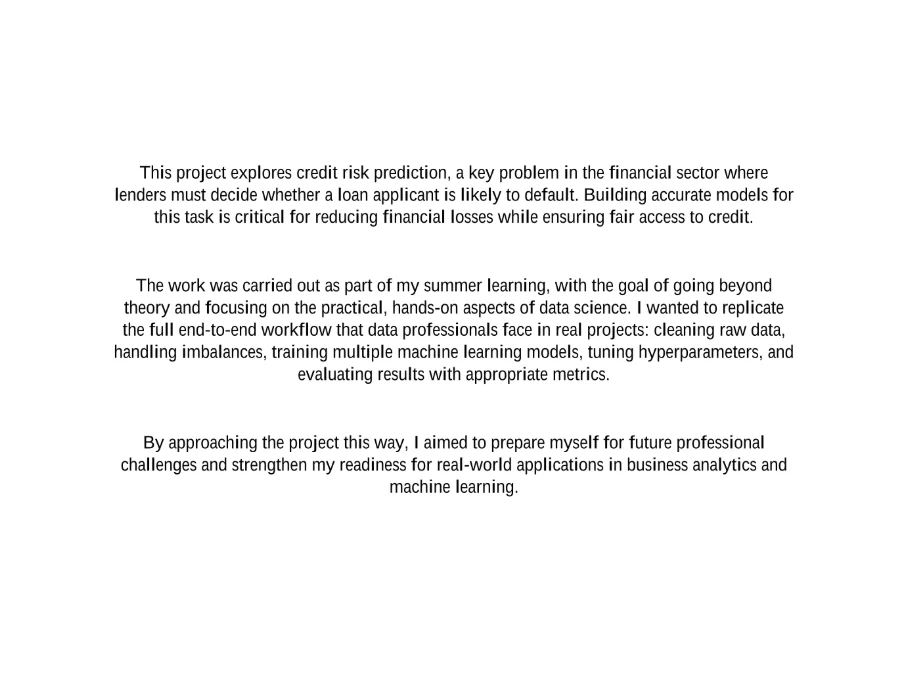
Explains the lending problem, business consequences, and scope of the modelling workflow.
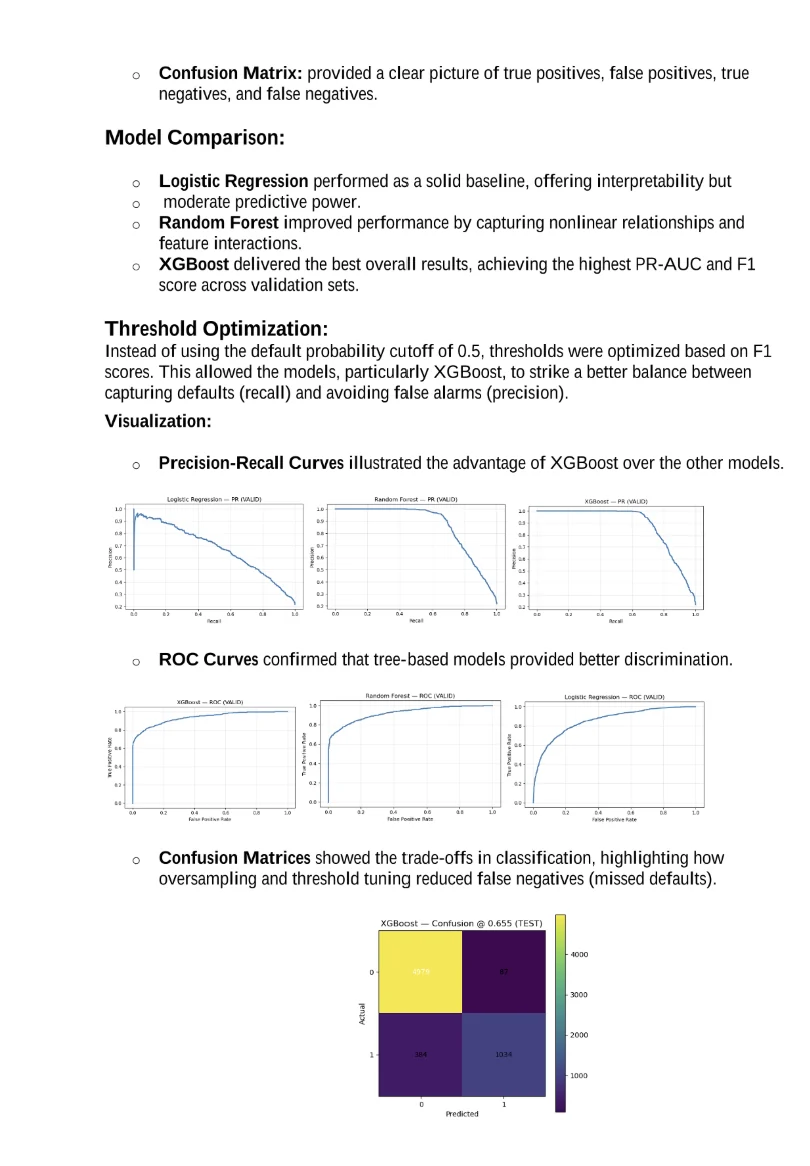
Communicates model comparison, threshold trade-offs, and classification errors visually.