Situation
Used-car buyers face inconsistent prices, incomplete listings, inspection uncertainty, and stressful negotiation, with no single tool connecting a price estimate to what to actually do next.
Data Science
A used-car decision tool combining prepared listing data, CatBoost price estimation, uncertainty ranges, prediction drivers, and a grounded local RAG consultant.
View source repository↗
Why it matters
My role
Used-car buyers face inconsistent prices, incomplete listings, inspection uncertainty, and stressful negotiation, with no single tool connecting a price estimate to what to actually do next.
Build a decision tool that estimates price with calibrated uncertainty, explains what is driving the number, and grounds practical inspection and negotiation guidance in real domain knowledge rather than a black-box prediction.
Buyers get a transparent price estimate, a clear account of what moved it, and concrete next steps for inspection or negotiation, turning a single number into a decision they can act on. Quantitative accuracy results remain unpublished until the original evaluation evidence is recovered.
Technical implementation
Each layer connects an implementation choice to the decision or workflow it supports.
06 layers| Layer | Implementation | Operational purpose |
|---|---|---|
| Feature preparation | Consistent preparation of brand, model, year, mileage, power, fuel, gearbox, damage and location fields | Keep training and live inference inputs aligned |
| Price estimation | CatBoost regression using mixed numerical and categorical vehicle attributes | Estimate listing value while modelling nonlinear feature interactions |
| Uncertainty | Prediction interval displayed alongside the point estimate | Communicate that a vehicle price is a range rather than a guaranteed number |
| Explanation | Leading positive and negative prediction drivers | Show which vehicle characteristics moved the estimate |
| Grounded retrieval | Markdown chunking, embeddings and retrieval for inspection, paperwork, maintenance and negotiation guidance | Ground assistant answers in a controlled local knowledge base |
| Product delivery | FastAPI, Next.js and a local LLM through an OpenAI-compatible LM Studio endpoint | Deliver prediction and guidance in one coherent, failure-aware workflow |
Product walkthrough
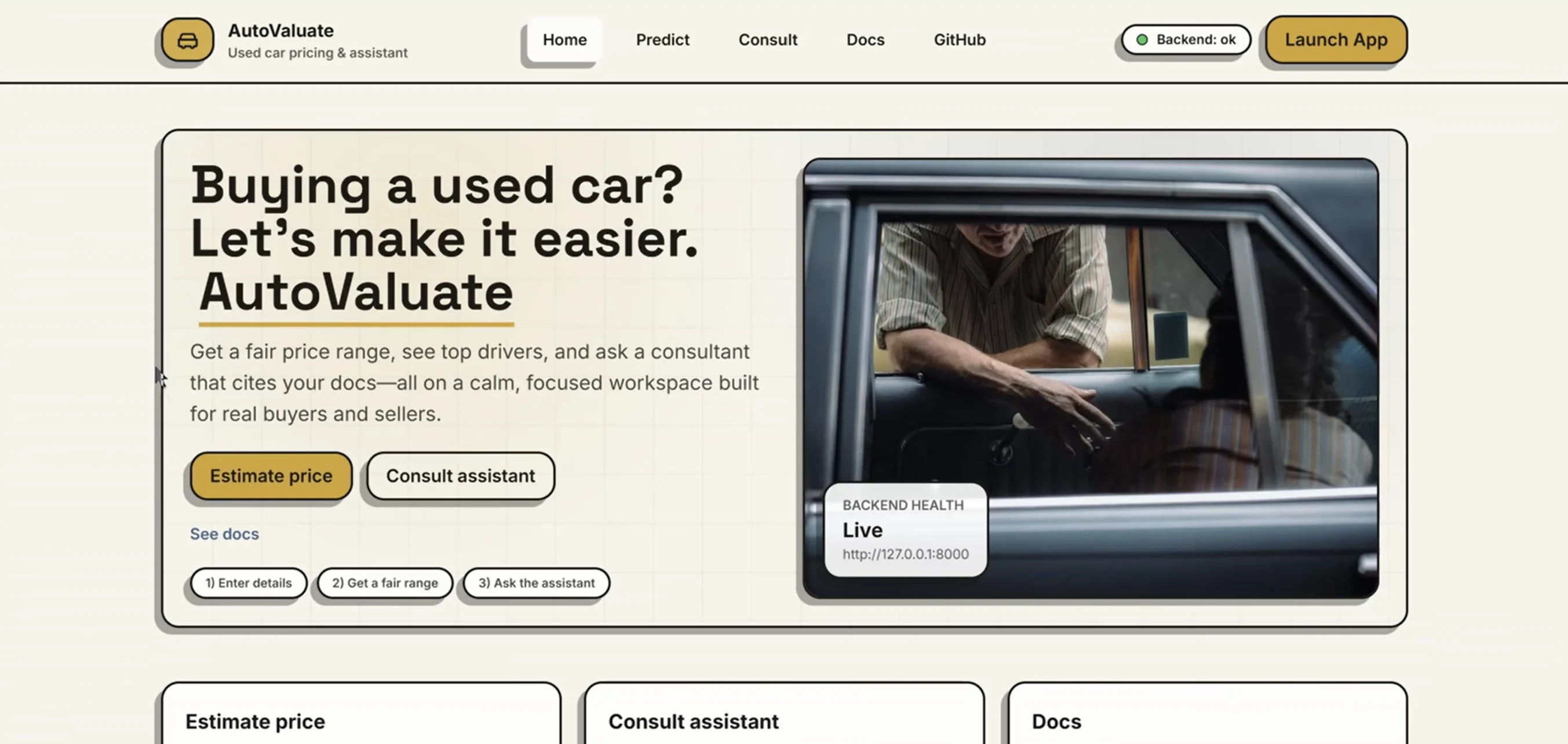
Introduces the product promise and guides users directly toward its two principal actions.
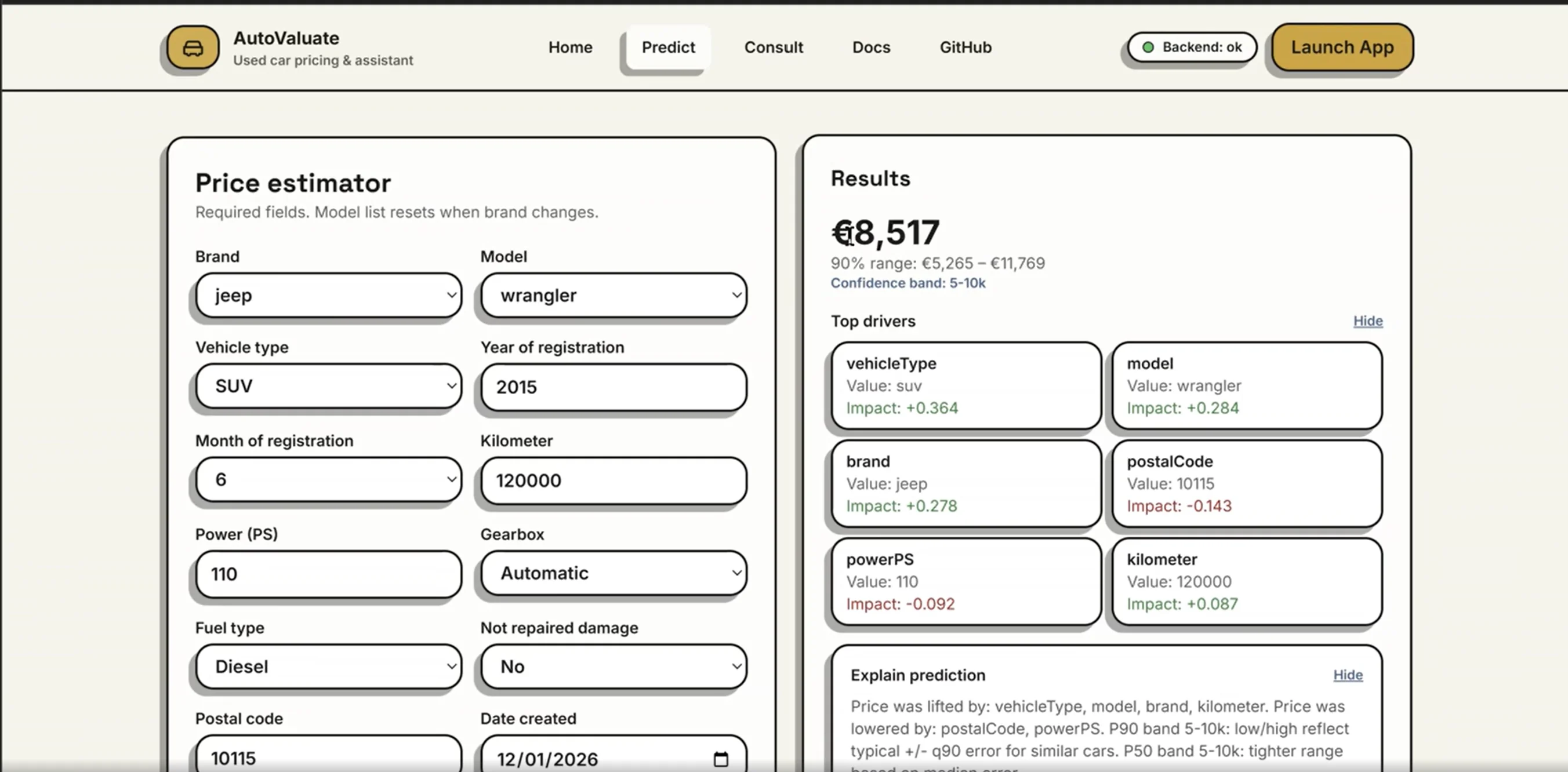
Collects vehicle characteristics, returns a price range, and exposes the factors influencing the estimate.
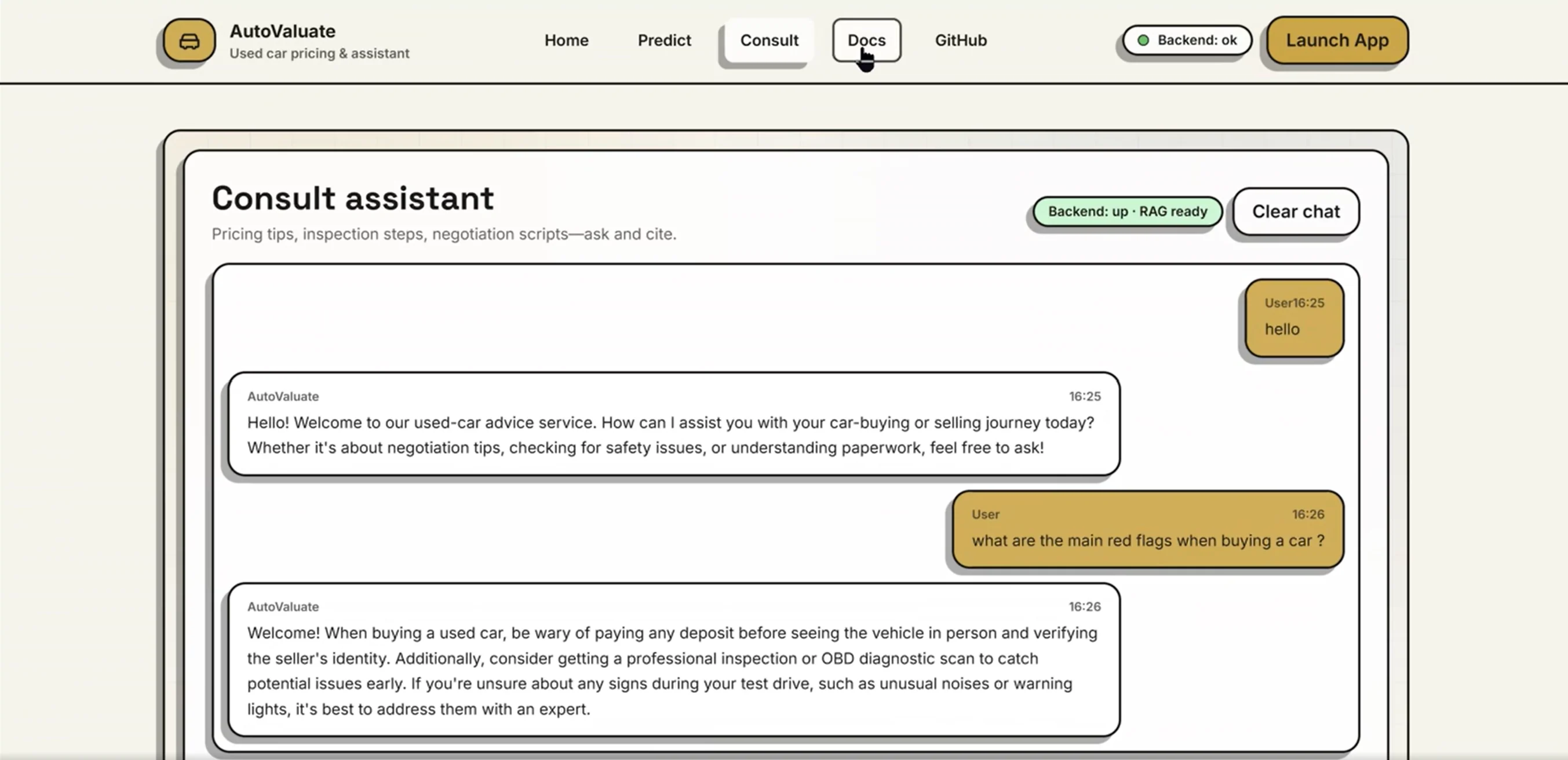
Provides grounded buying guidance through a focused conversational interface and suggested questions.
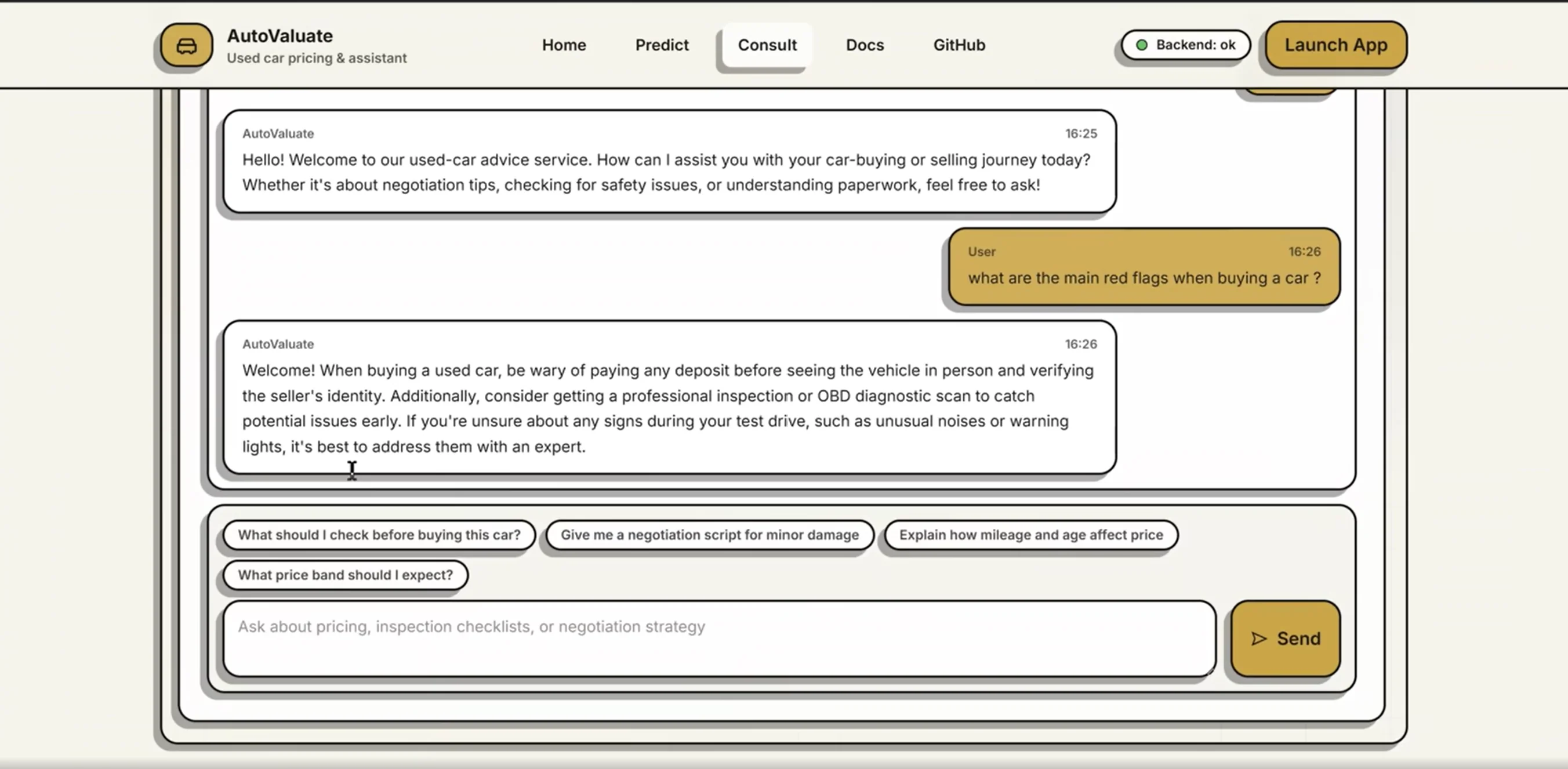
Shows how practical inspection and negotiation advice is delivered within the same product flow.